STEM Gift Ideas for Curious Kids Ages 8–12
Some children take things apart to see what is inside. Some ask “but how does it work?” ten times a day. If you are buying a gift for a child like that, this guide will help you choose one that still gets used after the wrapping paper is gone.
There are no rankings and no product names here. You will find a simple way to choose, and six kinds of gifts that suit ages 8 to 12.
A four-question checklist before you buy
1. Can the child use it mostly alone? A gift that needs an adult for every step often ends up on a shelf. Look for clear instructions and a first success within about fifteen minutes.
2. Does it explain why, and not only what? A kit that says “connect A to B” teaches following steps. A gift that also explains why the light turns on teaches science.
3. Will it still be interesting the second time? Open-ended gifts, where the child can build, change, or ask something new, last longer than gifts with one fixed result.
4. Does it match what the child already asks about? A child who asks how video games are made wants something different from a child who asks how planes stay in the air. Start from their questions.
Six kinds of STEM gifts that work
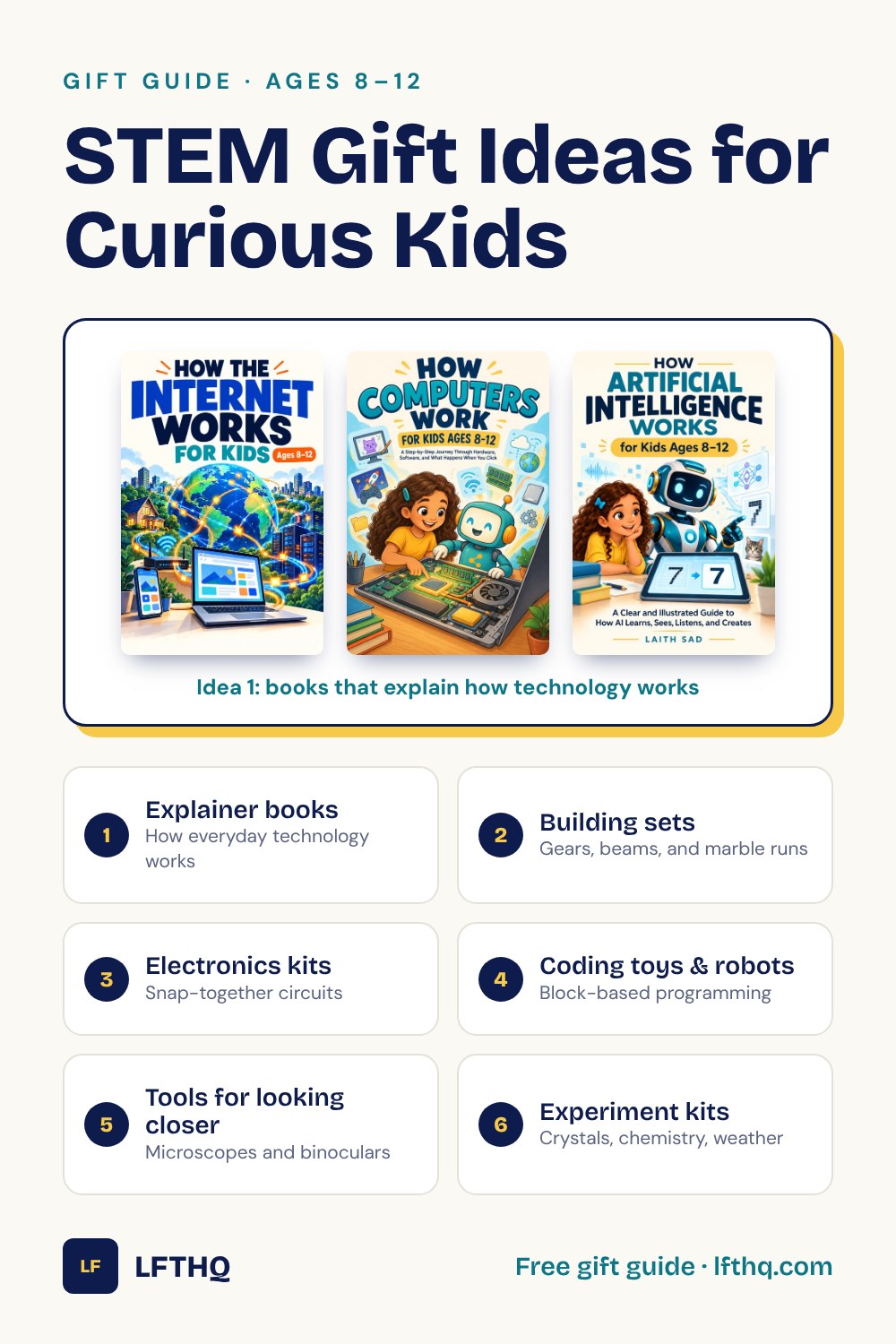
1. Books that explain how everyday technology works
Children use the Internet, computers, and AI tools every day, but few people explain what is happening behind the screen. A good explainer book answers those questions in order, with pictures, and the child can come back to it whenever a new question comes up. Books are also easy to wrap, easy to post, and need no batteries.
This is the kind of book we publish at LFTHQ. Our How Technology Works for Kids series is written for ages 8–12:
- How the Internet Works for Kids: networks, websites, online safety, and privacy.
- How Computers Work for Kids: hardware, software, and what happens when you click.
- How Artificial Intelligence Works for Kids: machine learning, chatbots, robots, and using AI wisely.
2. Building and engineering sets
Sets with gears, beams, pulleys, or marble tracks teach how forces and structures behave. Choose one that allows free building as well as following a plan.
3. Beginner electronics kits
Snap-together or clip-together circuit kits let a child light a bulb, sound a buzzer, or spin a motor without soldering. They turn the idea of a circuit into something a child can see and touch.
4. Coding toys and beginner robots
For this age, look for block-based coding, where commands are dragged into place instead of typed. The child should be able to change the program and see the robot or character behave differently.
5. Tools for looking closer
A simple microscope, a magnifier, or a pair of binoculars turns a garden, a kitchen, or a night sky into something to investigate. Add a notebook so the child can draw what they see.
6. Science experiment kits
Crystal growing, simple chemistry, and weather kits work well when the instructions explain the science behind each result. Check the age label and how much adult help is needed.
Time is a STEM gift too. Our guide to seven screen-free activities needs only paper, pencils, and an adult willing to play.
Matching the gift to the age
Ages 8–9: shorter projects, bigger pieces, lots of pictures, and quick results. Reading together still helps.
Ages 10–12: longer projects, more reading, and more freedom to design their own version. Children this age often enjoy a gift that treats them as capable.
A book and a hands-on kit on the same topic make a strong pair. One explains the idea, and the other lets the child try it.
Questions to ask the child first
- What is one thing you use every day that you would like to understand better?
- Would you rather read about how something works, or build it first?
- If you could invent one machine, what would it do?