What Is AI Training Data?
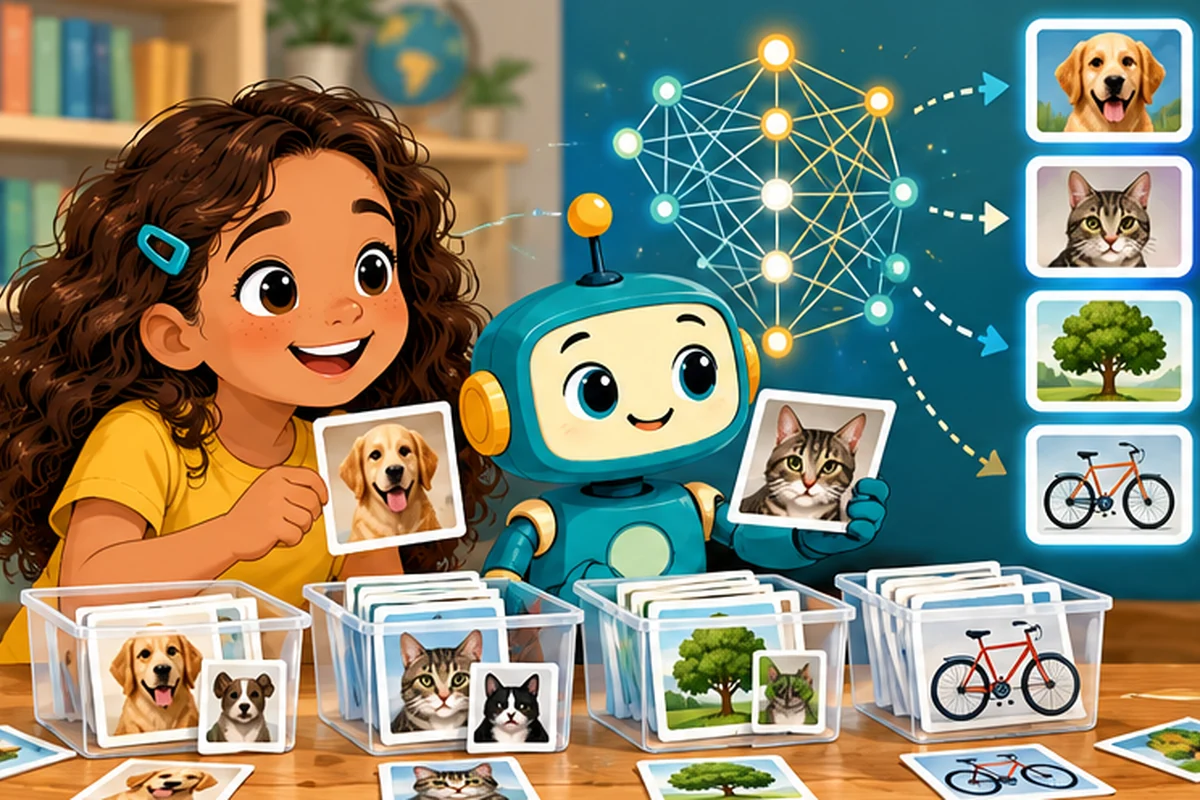
Imagine teaching a computer to tell a cat from a dog. You could try writing hundreds of rules about whiskers, ears, tails, and fur. But there is another approach: show the computer lots of examples and let a machine-learning model adjust itself to recognize useful patterns.
The examples used for that learning are called training data.
What counts as training data?
A dataset is an organized collection of examples. A dataset might contain pictures, words, numbers, recordings, or other information. For a simple pet-picture classifier, each example could contain an image and a label that says “cat” or “dog.”
During training, the model makes predictions and adjusts internal settings based on a learning process. After many examples, it may become better at predicting labels for pictures it has never encountered.
Why does variety matter?
Suppose every dog in your training set is photographed outside in a green field, while every cat is photographed inside on a sofa. The model might learn “green grass means dog” instead of learning useful clues about the animals themselves.
Now show it a cat sitting on grass. It may get confused. This is a simplified example of a data bias problem: the examples did not represent enough of the situations the model will meet.
Training data should be relevant, varied, and appropriately collected. Quantity alone does not guarantee quality.
Training, validation, and testing are different
A student should not be judged only on the exact practice questions they have memorized. AI models have a similar problem.
- Training examples are used while the model learns.
- Validation examples help developers choose and adjust their approach.
- Test examples are held back to check how the finished approach performs on unfamiliar data.
These groups should be kept appropriately separate. If the same examples leak into testing, results can look better than the model's true ability.
Does AI store every training example?
Models typically store learned numerical settings rather than an ordinary file folder of every example. But memorization and reproduction of training material can still happen in some circumstances. That is one reason training-data privacy and rights matter.
Why shouldn't I share private pictures for training?
Photos can contain faces, school names, addresses, or other personal information. Before anyone uses images or recordings of real people in an AI project, they should think about consent, permissions, and the service's privacy policies.
Try it: train a human classifier
Draw twelve simple shapes: circles, squares, triangles, and stars. Color half of the circles blue and half red, but make almost every star yellow. Show a friend eight examples labeled with the shape name. Then ask them to classify four new drawings, including a blue star. Did color help or trick them? Discuss which clue really matters: color or shape.
Quick questions
Is more data always better? No. Incorrect, repetitive, or unrepresentative data can cause problems.
Can a model be good at training examples but bad at new ones? Yes. This is one form of overfitting.
Does training data make AI understand the world like a child? No. It helps models learn useful patterns for particular tasks; human understanding is different.
Keep exploring
Read the introduction What Is Artificial Intelligence for Kids? and see why chatbots can make mistakes. Visit the How Artificial Intelligence Works for Kids book for more activities and illustrations.