How Do Video Games Work?
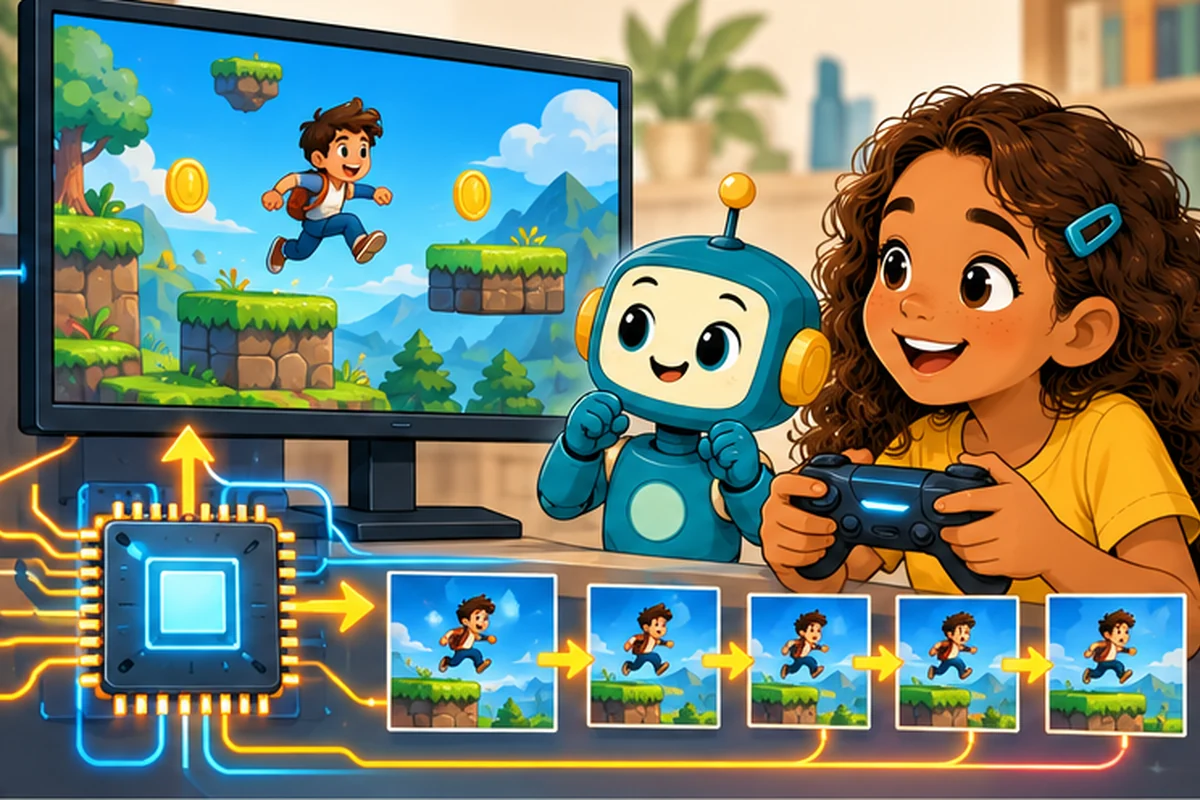
When you press a jump button, a character rises, lands on a platform, and collects a glowing coin. That tiny moment depends on several systems working together. A video game is not just an animated picture; it is a program that responds to your choices.
The game loop: listen, update, draw
Many games repeat a cycle called the game loop. During each cycle, the game reads input from a controller or keyboard, updates what is happening, and draws another frame on the screen.
Imagine a character waiting by a river:
- Input: You press the right arrow.
- Rules: The game checks whether moving right is allowed.
- Update: The character's position changes.
- Draw: A new picture shows the character slightly farther right.
- Repeat: The cycle continues, sometimes many times per second.
This process explains why a game can react so quickly. It also explains why performance matters. If the computer cannot keep up with its work, motion may look jumpy.
What are game rules?
Games store information such as your score, remaining lives, position, and inventory. This changing information is called game state. Rules decide what to do with it. If you touch a coin, the game might remove the coin and increase your score. If you run into a wall, it might stop your movement.
Some games simulate physics—ideas such as gravity, speed, and collisions. A physics system can help a ball bounce or a character fall, though game physics may be simplified to make the experience more fun.
How do pictures and sounds appear?
Artists make characters, scenes, shapes, and animations. Programmers and game engines tell the computer when and where to show them. The graphics processor (GPU) often helps draw the frames. Sound systems play music and effects at the right moments.
The images on the screen are not the whole game. The hidden rules are what make them interactive.
Does every opponent use AI?
Not necessarily. A game opponent might follow rules such as “patrol until you see the player” or “turn left when you reach a wall.” Other games use more advanced planning or machine-learning techniques. Smart-looking behavior does not always require modern generative AI.
Why can games lag?
Lag is a general word players use for unwanted delay. A slow response might come from a device drawing frames slowly, a busy game server, or network delay in an online match. Those are different problems and may need different solutions.
Try it: invent a paper platform game
Draw a character, a wall, two coins, and a finish line. Write three rules: “move one square per turn,” “walls stop movement,” and “each coin adds one point.” Ask a friend to play by giving commands. Now invent a fourth rule: “a hole makes you start again.”
You have created a small game state, a set of rules, and an input system—all without a computer.
Quick questions
Are online games entirely stored on a server? Not always. Many parts run on your device, while servers may coordinate players or store shared information.
Does high frame rate guarantee no lag? No. Network delays can still affect an online game.
Keep exploring
See What Is Coding? Explained for Kids, What Is an Algorithm?, and What Is a Computer Bug?. For a wider look at processors and graphics, explore How Computers Work for Kids.