Balance Transfer Checklist: 7 Questions to Ask Before You Say Yes
A balance transfer offer can look like a way out: move your card balance to a new card with a low or 0% promotional rate, and stop paying so much interest. It can help. It can also cost you more if you do not read the details first.
How a balance transfer works
You move debt from one or more cards onto another card. For a set number of months, the moved balance is charged a lower promotional rate. When the promotion ends, any balance still left is charged the card’s regular rate.
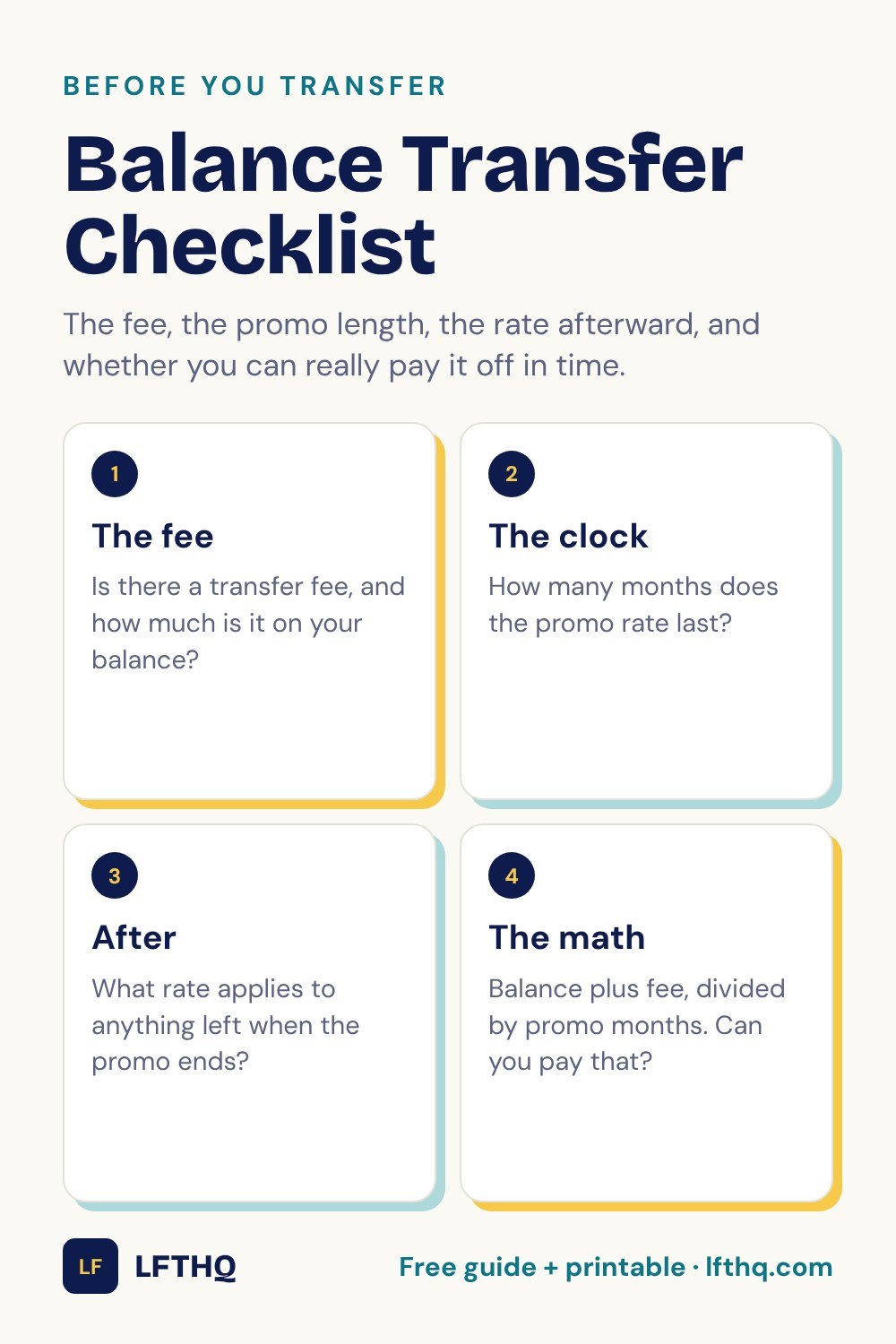
The goal is simple: pay off as much as possible, ideally all of it, while the low rate lasts.
Seven questions to ask
Find the answers in the offer and the card agreement, or ask the card issuer before you apply.
- What is the transfer fee? Many cards charge a fee on the amount you move, often a percentage. Work out the dollar amount on your own balance.
- How long does the promotional rate last? Count the months, and note the exact end date.
- What rate applies after the promotion ends? That is what you will pay on anything left.
- Can I transfer my whole balance? The new card’s credit limit may be lower than what you owe, and the fee usually counts toward the limit.
- Do new purchases get the same low rate? Often they do not. Using the new card for shopping can make the plan harder to follow.
- What can end the promotion early? Check what the terms say about a late or missed payment.
- Can I move a balance from a card with the same bank? Many issuers do not allow transfers between their own cards.
Do the math first
Add the transfer fee to the balance, then divide by the number of promo months. That is roughly the monthly payment you need to clear it in time.
Hypothetical example: you move $4,000 to a card with a 15-month 0% promotion and a 3% transfer fee. The fee is $120, so you owe $4,120. Divided by 15 months, that is about $275 a month.
If that payment does not fit your budget, the transfer may still lower your interest, but plan for what you will owe when the promotion ends. A budget built around essentials first helps you see what you can really afford.
A balance transfer card is a new credit application. Approval, credit limit, and terms depend on the issuer and your credit history.
After you transfer
- Set up at least the minimum payment automatically so you never miss one.
- Pay your monthly target amount, not only the minimum.
- Avoid running the old card’s balance back up.
- Mark the promo end date on your calendar and on the free tracker below.
This guide is general financial education, not personal financial, legal, or tax advice. Card terms vary, so check your own card agreement and statements.